C++ Book vs Course vs YouTube: Which Actually Works?
You have decided to learn C++. Now you have to pick how — and the options all claim to be the best. This is an honest comparison of the three main routes, what each is genuinely good at, and where each one quietly fails people.
The short version: the format matters less than whether you finish it. Almost everyone who fails to learn C++ fails for the same reason, and it is not the one you would expect.
The Real Reason People Fail at C++
It is not difficulty. It is drift.
A typical path looks like this: watch a few videos on variables, follow a different tutorial on loops, get to pointers, find the explanation confusing, search for a better one, land in a new series that starts again at variables. Three months later you have watched twenty hours of content and can still only write the same beginner programs.
Drift happens when there is no defined path and no finish line. Every format on this list can either prevent that or make it worse.
If you choose a book
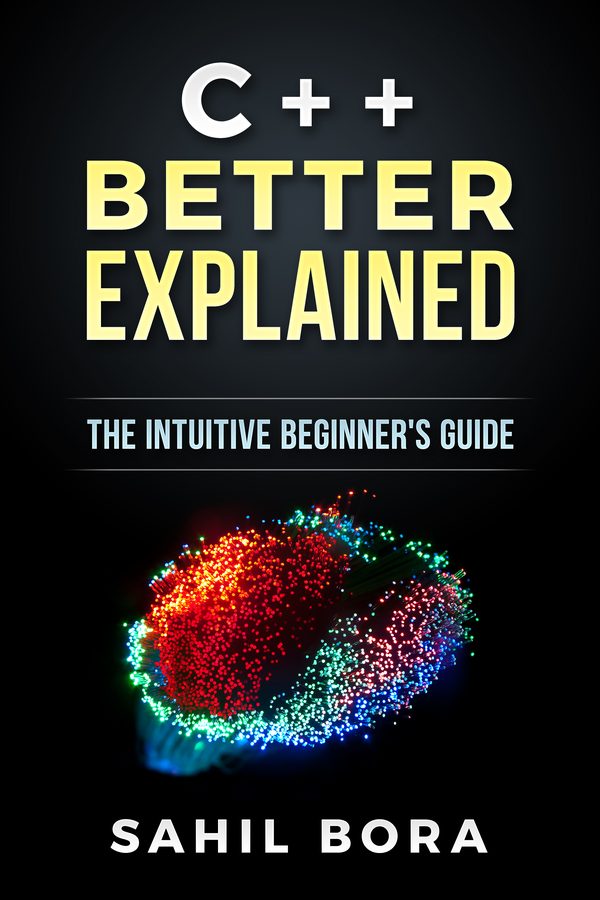
C++ Better Explained
The beginner book built around plain-English mental models — pointers, memory and OOP finally click. 87 focused pages instead of a 1,000-page textbook.
Get the Book — $19 →Option 1: Books
Best for: depth, reference, and learners who like to read at their own pace.
A good book gives you one consistent voice, a deliberate order, and material you can search, annotate, and return to. You cannot skim a book the way you can zone out during a video — reading is active, so retention tends to be better.
Where books fail: most people buy the wrong one. The famous C++ books are references written for people who already program professionally. Handing a complete beginner a 1,300-page tome is how you end up with an unread book and the conclusion that C++ is impossible.
Pick a book that matches your level, not the one with the biggest reputation. For beginners that means something focused and finishable, not comprehensive. A book you finish beats a better book you abandon on page 90.
Option 2: Online Video Courses
Best for: structure, momentum, and people who learn better by watching someone type.
A well-built course sequences everything for you, which directly attacks the drift problem. Watching someone write code in real time — including their mistakes and fixes — teaches things a static page cannot, especially around tooling, compiling, and debugging.
Where courses fail: completion rates. Industry-wide, most people who buy an online course never finish it. Video also makes it easy to feel productive while passively watching, and it is slow to reference later — nobody wants to scrub through a 40-minute video to recheck one piece of syntax.
Cost varies enormously, and price does not track quality. An expensive course you do not finish is worse value than a cheap book you do.
Option 3: YouTube
Best for: solving one specific problem, right now, for free.
YouTube is unbeatable when you are stuck on something concrete: how to set up your compiler, what a segmentation fault means, how std::find works. Free, immediate, and often better explained than paid material because creators compete on clarity.
Where YouTube fails: as a primary curriculum. There is no defined order, no finish line, and no accountability. Quality varies wildly and outdated videos rank alongside current ones — plenty of highly-viewed C++ tutorials still teach practices that modern C++ has moved past. And the algorithm is designed to keep you watching, which is not the same as keeping you learning.
Used as a supplement, YouTube is excellent. Used as your whole plan, it is where most beginners quietly stall.
Side-by-Side
| Book | Video Course | YouTube | |
|---|---|---|---|
| Structure | Strong | Strongest | Weakest |
| Depth | Strongest | Medium | Varies wildly |
| Easy to reference later | Yes | Poor | Poor |
| Cost | Low to medium | Medium to high | Free |
| Risk of drifting | Low | Low while enrolled | High |
| Best used for | Core learning + reference | Core learning + tooling | Filling specific gaps |
What Actually Works: Combine Them
The learners who get through C++ almost always do the same thing: one structured backbone plus targeted supplements.
- Pick one primary resource — a beginner-appropriate book or a single course. This is your path, and you follow it to the end.
- Use YouTube tactically. Stuck on pointers after reading about them? Watch one video on pointers, then go back to your path. Do not let it become the path.
- Write code the same day you learn it. Reading about loops teaches you almost nothing. Writing five small programs with loops teaches you loops.
- Build small projects early. A number guessing game or a calculator will teach you more than another chapter.
Which Should You Choose?
- Complete beginner, limited budget, wants a clear path: a focused beginner book, supplemented with free tutorials and YouTube for gaps.
- Learns best by watching, has budget, wants hand-holding: a structured video course — but commit to finishing it.
- Already programs in another language: a book, almost certainly. You do not need someone explaining what a variable is; you need the C++-specific parts fast.
- Stuck on one topic: YouTube or a targeted article. No need to buy anything.
If you want the free route, it genuinely exists and it is good — the full breakdown of what is worth your time is in best C++ books and resources.
Take Your C++ Further
If the “one structured backbone” approach sounds right and you want it to be short rather than a 1,300-page reference, that is exactly what the C++ Better Explained Ebook is: 87 pages that take you from your first program through pointers, memory, and OOP in plain English, with the analogies and diagrams that make the hard parts click. Just $19.
👉 Get the C++ Better Explained Ebook — $19
Related Guides
- Best C++ Books and Resources for Beginners in 2026 — every option ranked honestly, including the free ones.
- How to Learn C++ From Scratch: The Complete Roadmap — the structured path itself, free and in order.
- How Long Does It Take to Learn C++? An Honest Timeline — what to expect from each stage.
- Is C++ Worth Learning in 2026? An Honest Answer — if you are still deciding whether to commit.
- Is C++ Hard to Learn? An Honest Answer for Beginners — what makes it difficult and how to get past it.
- Is C++ Primer Good for Beginners? — the most-recommended book, reviewed honestly