A Tour of C++ (3rd Edition) Review
Short answer: A Tour of C++ is an excellent book for the reader it was written for: an experienced programmer who wants a fast, modern overview of C++. It isn’t a beginner’s book, and its author says so. If you’ve never programmed, start somewhere gentler and come back to it later. It’ll make far more sense then.
Disclosure: I wrote C++ Better Explained, a paid book for beginners. I’ll be clear about where A Tour of C++ is the better choice.
New to programming?
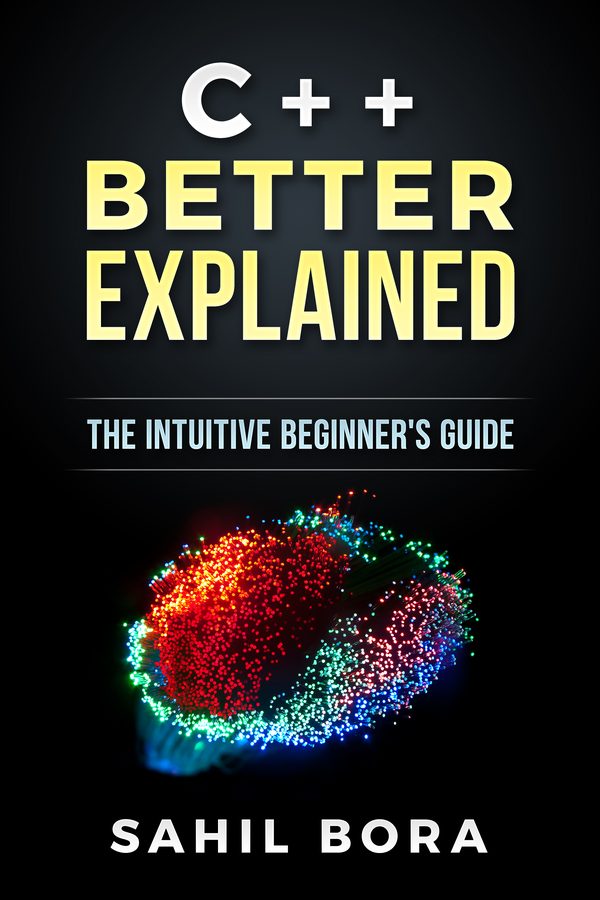
C++ Better Explained
A Tour of C++ assumes you already program. If you don't yet, this short book explains pointers, memory and OOP for true beginners, in 87 plain-English pages with diagrams.
Get the Book — $19 →The Facts
| Author | Bjarne Stroustrup, the creator of C++ |
| Publisher | Addison-Wesley |
| Edition | 3rd edition, September 2022 |
| Length | About 254 pages plus index (Stroustrup’s figure) |
| C++ standard | C++20, plus a few features expected in C++23 |
| Written for | People who already know C++, or experienced programmers |
What It Covers
The book is a quick tour of the whole of standard C++, both the language and the standard library, at what Stroustrup calls “a moderately high level”. It has 19 chapters plus an appendix:
- The language: basics, user-defined types, modularity and separate compilation, error handling, classes, copy and move, templates, and C++20 concepts.
- The standard library: strings and regular expressions, input and output, containers, algorithms, ranges, pointers and containers, utilities, numerics, and concurrency, including coroutines.
- Context: a chapter on the history of C++, and an appendix on using the standard library as a module.
It’s remarkable how much fits into about 250 pages. That’s also the reason it’s hard going for beginners.
What It Does Well
It’s fast. You see all of modern C++ in a few evenings, and you come away knowing what exists and where it fits.
It’s modern. Concepts, ranges, modules and coroutines are all there. If your knowledge of C++ stops at C++11, this is the quickest way to catch up.
It’s from the source. Stroustrup shows C++ the way it’s meant to be used, and each chapter ends with practical advice.
It shows how the pieces fit. Instead of teaching features one at a time, it shows how the language and library work together.
Why It’s Hard for Beginners
It assumes you can already program. Stroustrup’s own description says the book is for people “who already know C++ or at least are experienced programmers”. That isn’t modesty. The book is designed that way.
It moves very quickly. Chapter 1 covers programs, functions, types, scope, constants, pointers, arrays and references in under 20 pages. Pointers, arrays and references get about three of those pages. For someone who’s programmed before, that’s a useful refresher. For someone who hasn’t, it’s far too fast.
It explains what, not how to think. A beginner needs a lot of repetition and practice with the basics. A tour, by design, doesn’t stop for long.
Who Should Read It
- Programmers coming from Python, Java, C# or JavaScript who want to understand modern C++ quickly.
- C++ programmers returning after a break, or catching up with C++20.
- Students after a first C++ course, as a way to see the whole language at once.
What Beginners Should Read Instead
If you’re new to programming, Stroustrup himself points you to another of his books, Programming: Principles and Practice Using C++, which teaches programming from scratch. Your options:
- Programming: Principles and Practice Using C++ — Stroustrup’s book for people who have never programmed. Thorough, and 656 pages long.
- learncpp.com — free, starts from zero, and covers far more than a beginner needs.
- C++ Better Explained — a short, plain-English book with diagrams, focused on the parts beginners find hardest: pointers, memory and OOP. It’s 87 pages, so you can finish it, then read A Tour of C++ with the foundations in place.
A Tour of C++ vs Stroustrup’s Other Books
| A Tour of C++ (3rd ed.) | Programming: Principles and Practice (3rd ed.) | The C++ Programming Language (4th ed.) | |
|---|---|---|---|
| Published | September 2022 | 2024 | May 2013 |
| Length | About 254 pages + index | 656 pages | 1,300+ pages |
| Written for | Experienced programmers | People who have never programmed | Programmers who want the complete language |
| C++ standard | C++20 | C++20 and C++23 | C++11 |
Wondering about the big one? See is The C++ Programming Language good for beginners?
The Verdict
For an experienced programmer, A Tour of C++ is one of the best C++ books you can buy: short, modern and written by the person who designed the language. For a beginner it’s the wrong first book. That’s no criticism of the book; it simply wasn’t written for you yet. Learn the fundamentals first, and keep it on your list for later.
Take Your C++ Further
If you'd like the fundamentals explained in one place, C++ Better Explained covers them in 87 plain-English pages, with analogies and code diagrams, including the parts that trip beginners up most: pointers, memory and OOP.
Get the book — $1987 pages · plain English · 30-day money-back guarantee
Related Articles
- Best C++ Books and Resources for Beginners — every option, ranked honestly.
- Programming: Principles and Practice Review — Stroustrup’s beginner book.
- Is C++ Primer Good for Beginners? — the other classic textbook.
- C++ Primer vs Programming: Principles and Practice — which of the two to pick.
- Is The C++ Programming Language Good for Beginners? — Stroustrup’s complete reference.