Is learncpp.com Enough to Learn C++?
Short answer: yes — for learning the C++ language, learncpp.com is enough for most people. It’s free, it assumes no programming experience, and it covers far more than a beginner needs. The catch is that it’s long, and long is where self-learners stall. What you’ll want to add is practice of your own, and sometimes a second explanation when a topic won’t click.
Disclosure: I wrote C++ Better Explained, a paid book for beginners. learncpp.com is free, and for plenty of people it’s all they need. I’ll say plainly where that’s the case.
Want a shorter first pass?
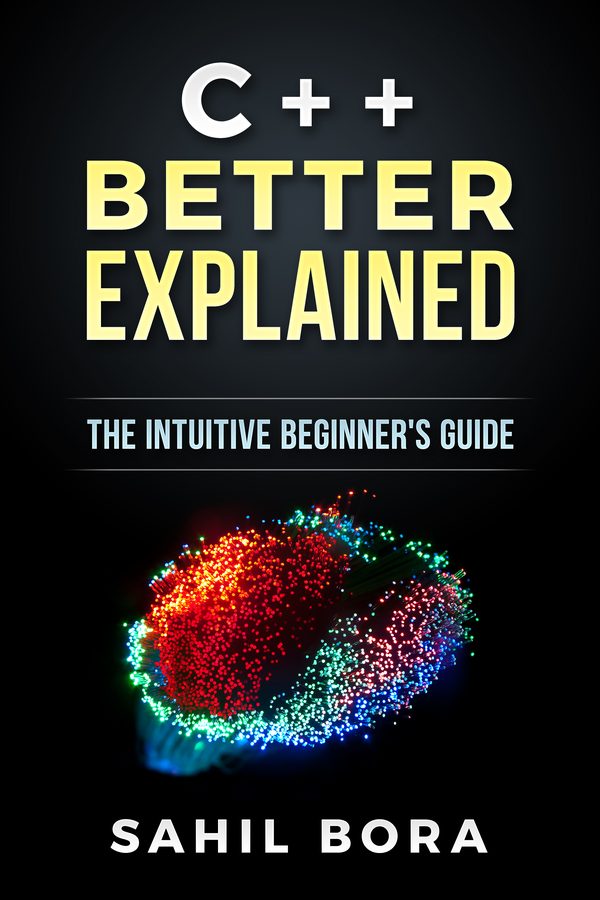
C++ Better Explained
learncpp.com is thorough and free. If you'd like the hard parts first — pointers, memory and OOP — in 87 plain-English pages with diagrams, this book is built for true beginners.
Get the Book — $19 →What learncpp.com Covers
The tutorial runs from chapter 0 to chapter 28, plus a few optional chapters and appendices. In order, roughly:
| Chapters | What they cover |
|---|---|
| 0–3 | Setting up a compiler, your first program, the basics, functions and multiple files, and debugging |
| 4–11 | Data types, constants and strings, operators, scope and linkage, control flow, error handling, type conversion, overloading and function templates |
| 12–13 | References and pointers, then enums and structs |
| 14–17 | Classes, std::vector, std::array and C-style arrays |
| 18–20 | Iterators and algorithms, dynamic allocation, the stack and the heap, recursion and lambdas |
| 21–23 | Operator overloading, move semantics and smart pointers, and how objects relate to each other |
| 24–28 | Inheritance, virtual functions, templates and classes, exceptions, and input/output |
| Appendix B | What changed in C++11, C++14, C++17, C++20 and C++23 |
That’s a complete path from zero to intermediate C++, and it’s free.
What It Does Well
It starts from zero. The site says no prior programming experience is necessary, and it means it: chapter 0 walks you through installing a compiler before you write any code.
It teaches modern C++. You’ll see std::string_view, constexpr and smart pointers, not just the C-style code older tutorials lean on.
It teaches habits, not just syntax. Lessons regularly point out best practices and common mistakes, and there’s a whole early chapter on debugging, which beginner material often skips.
It checks your understanding. Each chapter ends with a summary and a quiz.
It’s maintained. The site keeps a public list of its latest changes, so lessons get revised over time.
Where Self-Learners Stall
None of these is a flaw in the site. They’re what happens when anyone learns C++ alone from any resource.
It’s long. Hundreds of lessons is a lot to get through with no teacher and no deadline. If you stop, it’s usually from running out of momentum, not because the material was wrong.
Reading isn’t programming. You can follow every lesson and still freeze in front of an empty file. You learn to program by writing programs.
Some chapters are still being reworked. On the site’s own index, the iterators-and-algorithms and dynamic-allocation chapters are marked under construction.
Pointers and memory are hard everywhere. References and pointers arrive in chapter 12, and they’re where many people’s progress slows. That’s not learncpp’s fault — it’s the hardest idea in beginner C++.
What to Add Alongside It
- Your own small programs. After every chapter or two, build something with what you’ve learned. Our 40+ beginner programs and guided projects give you something to build.
- A setup that works. If the compiler fights you, everything else stalls. See how to set up C++.
- A second explanation for the hard parts. When a topic won’t click, reading the same idea explained differently often fixes it — a video, a friend, or a short book with diagrams.
learncpp.com vs a Book
| learncpp.com | C++ Primer (5th ed.) | Programming: Principles and Practice (3rd ed.) | C++ Better Explained | |
|---|---|---|---|---|
| Cost | Free | Paid | Paid | $19 |
| Length | Hundreds of lessons | Just under 1,000 pages | 656 pages | 87 pages |
| Assumes you’ve programmed before? | No | Yes | No | No |
| Best for | A complete free path | A precise, thorough reference | Learning to program, from C++‘s creator | A short, plain-English start on the hard parts |
More detail in our reviews of C++ Primer and Programming: Principles and Practice.
The Verdict
- Never programmed, patient, and want free? Work through learncpp.com and build small programs as you go. You may not need anything else.
- Want a quicker way into pointers, memory and OOP first? A short book can get you over those humps, then learncpp.com fills in the breadth.
- Already program in another language? You can move faster through learncpp.com, or start with a shorter overview such as A Tour of C++. More options in the best C++ books and resources.
Take Your C++ Further
If you'd like the fundamentals explained in one place, C++ Better Explained covers them in 87 plain-English pages, with analogies and code diagrams, including the parts that trip beginners up most: pointers, memory and OOP.
Get the book — $1987 pages · plain English · 30-day money-back guarantee
Related Articles
- Best C++ Books and Resources for Beginners — the full list, free options included.
- How to Learn C++ on Your Own — a self-study plan that works.
- C++ Book vs Course vs YouTube — choosing your main resource.
- Programming: Principles and Practice Review — Stroustrup’s book for learning to program.
- How Long Does It Take to Learn C++? — realistic timelines.