Can You Learn C++ on Your Own?
Yes — and most C++ developers largely did. You do not need a degree, a bootcamp, or a mentor. What you do need is a path, the discipline to write code most days, and a realistic picture of how long it takes.
This guide covers the self-taught route honestly: the order to learn things, what to build, and the specific traps that stall people who try it alone.
What Self-Learners Actually Lack
It is worth naming the real disadvantage, because it is not what people assume.
Self-learners are not short on information — there is more free C++ material online than anyone could finish in a lifetime. What a course or teacher provides is sequencing and correction: someone deciding what you learn next, and someone catching your misunderstandings before they harden.
Both are replaceable. Sequencing comes from following one structured resource instead of grazing across many. Correction comes from writing code that fails loudly, and from asking specific questions when you are stuck. Once you solve those two things, self-teaching C++ is entirely tractable.
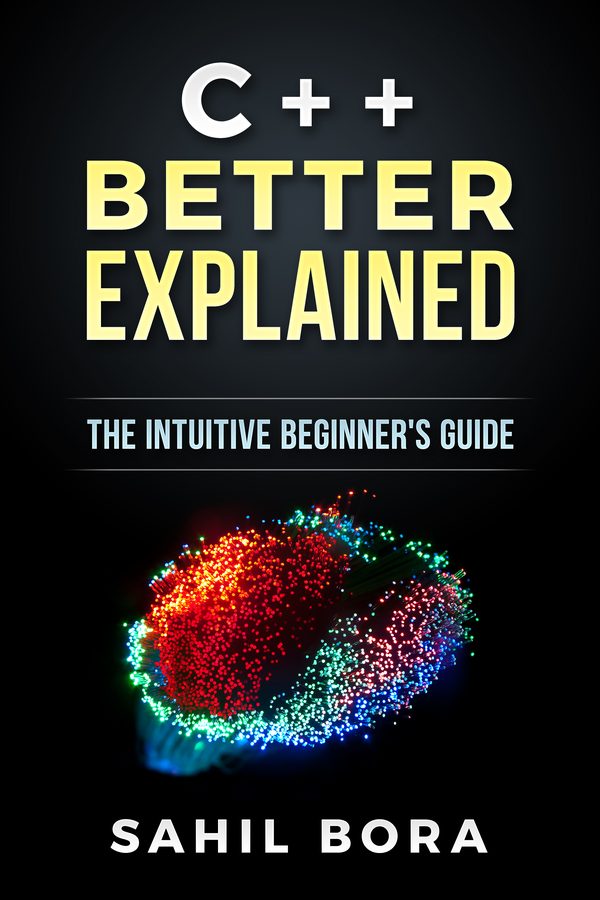
Learning on your own?
C++ Better Explained
Self-study stalls on the concepts with nobody to explain them. This book covers pointers, memory and OOP in 87 plain-English pages built for exactly that.
Get the Book — $19 →The Self-Taught Order That Works
Learn these in order. Each one depends on the one before it, and skipping ahead is the single most common reason people get confused and quit.
- Setup and your first program. Get a compiler working and understand what every line of Hello World does. Do not skip the setup step — many people quit here purely from tooling frustration.
- Variables and data types. How C++ stores values, and why types matter more here than in Python.
- Conditionals and loops. if/else and switch, then for, while, and do-while.
- Functions. How to break a program into parts, pass values, and return results.
- Arrays and strings. Arrays, then
std::string, then vectors — which you will use far more than raw arrays. - Pointers and memory. The hurdle everyone warns you about. Pointers, references, and the stack versus the heap. Take your time here; everything after it is easier once this clicks.
- Classes and OOP. Classes and objects, constructors, encapsulation, inheritance, polymorphism.
- The STL. Containers, iterators, and algorithms — the tools that make you productive rather than merely correct.
If you want this same sequence with every step linked in order, the complete C++ roadmap lays it out as a checklist you can work through.
Build Things, Early and Small
Reading about loops teaches you almost nothing. Writing a program that uses loops teaches you loops.
Start building in week one, before you feel ready. Good early projects:
- A number guessing game — loops, conditionals, and input in one small program.
- A calculator — functions and control flow.
- A grade calculator — arrays and averages.
- A Blackjack game — your first real object-oriented project.
Projects do something tutorials cannot: they surface the gaps in your understanding immediately. When your program crashes, you are forced to learn what actually went wrong — and that lesson sticks in a way passive reading never does.
The Four Traps That Stall Self-Learners
Tutorial hopping. Bouncing between resources every time something gets hard means you relearn variables five times and never reach pointers. Pick one path and finish it.
Watching instead of writing. Video is comfortable and feels productive. If you have watched more hours than you have typed, that ratio is the problem.
Skipping pointers. It is tempting to hurry past the hard chapter. Everything afterwards — memory management, data structures, why references exist — depends on it. Slow down and get it properly.
Waiting to feel ready. There is no moment when you will feel qualified to start a project. Start it badly, then fix it.
A Realistic Schedule
You do not need to quit your job. You need consistency.
- 1 hour a day, most days beats a six-hour session every other weekend. Programming knowledge decays fast between sessions.
- Split it roughly 30/70 — thirty percent learning something new, seventy percent writing code.
- Expect 2-3 months to be comfortable with fundamentals, 6-12 months to build real things confidently. The full breakdown is in how long it takes to learn C++.
Plateaus are normal, usually around pointers and again around OOP. They are not a signal that you lack aptitude — they are a signal you have reached the parts that actually change how you think.
When You Get Stuck
Getting stuck is the job, not a failure of it. What helps:
- Read the compiler error properly. C++ errors look intimidating but usually name the file, line, and problem. Decoding error messages is a skill worth building deliberately.
- Reduce the problem. Cut your code down to the smallest version that still breaks. Half the time you find the bug doing this.
- Ask specific questions. “My code does not work” gets ignored. “Why does this pointer print garbage after I return it from a function?” gets answered in minutes.
The Honest Bottom Line
Learning C++ alone is completely doable, and the internet has removed nearly every barrier except one: knowing what to do next. Solve that with a structured path, write code most days, build small things early, and do not rush pointers.
That is the whole method. It is not complicated — it is just consistent.
Take Your C++ Further
If the hardest part of self-teaching is knowing what to learn next, that is exactly the problem the C++ Better Explained Ebook solves. One path, in order, in plain English — from your first program through pointers, memory, and OOP, with the analogies and diagrams that make the hard parts finally make sense. Just $19.
👉 Get the C++ Better Explained Ebook — $19
Related Guides
- How to Learn C++ From Scratch: The Complete Roadmap — the full sequence as a checklist you can follow.
- How Long Does It Take to Learn C++? An Honest Timeline — realistic timelines per stage.
- Is C++ Hard to Learn? An Honest Answer for Beginners — what makes it hard and what makes it manageable.
- C++ Book vs Course vs YouTube: Which Actually Works? — choosing your primary resource.
- Best C++ Books and Resources for Beginners in 2026 — ranked honestly, free options included.
- C++ Projects for Beginners — guided projects with full source code.
- Is C++ Primer Good for Beginners? — whether the classic textbook suits self-study